
The Battle of Tupelo, or Harrisburg, July 14th, 1863
By Stephen D. Lee
General Lee made no report of the battle of Tupelo, or Harrisburg, during the war. It is therefore deemed pertinent to add to this account the following in way of explanation at this late day:
“It is a duty which we surviving Confederates owe our families and posterity to prepare and have in accessible form as many facts as possible in regard to the war, that historians in the future may not be in doubt or in the dark. It is not too late yet to correct some errors of record or omission. As a people at large we were not in a humor or favorable condition to write much about the great struggle until its memories began to fade, and the participants still living were greatly scattered and reduced in numbers.” As for myself, the busy demands of an active and exacting life have given me no time until the last three years to examine or study the exciting scenes of the great struggle of the sixties.
“The time has come when undue loyalty, sentiment and partisanship must give way before the cold facts of history as recorded in official reports and justice must be done to the American soldier without partiality or favor, and facts ought not to be suppressed because they affect the reputation of a dead man. The United States government has done what no other government ever did. It has prepared in 130 volumes the reports, correspondence, telegrams, maps and official material of the great struggle, giving equal credence to the papers on both sides. From this material history will be written, and while survivors may give their memories of events, these can only color or bring light on doubtful records. The facts are potent in official record, and will have right of way. ‘Memory after a long lapse of time is not always reliable.’ It is easy to criticize and attack in the light of circumstances that were not known at the time.
“The facts are, that Gen. Forrest never rendered a report to me during or after the war. I never had access to these reports, till they appeared in 1892, in the official record of the war by the United States government. I left the battlefield of Harrisburg to go to the great battles around Atlanta, and amid those scenes I had no time to dwell on my campaign in Mississippi. Gen. Forrest, too, was actively engaged. The great struggle was pressing everywhere to a speedy ending. Events followed events rapidly. I reported the battle in three brief telegrams to the War Department, awaiting an opportunity to make a full official report, which opportunity never came, but Gen. Forrest received all subordinate reports and made his official report direct to department headquarters, and not through me.
“I assert that the reports of Gen. Forrest, Gen. Chalmers and Gen. Buford, and the letter of Gen. Roddey, and the other reports, will bear out my version of the battle of Harrisburg, and that no other version will bear the test of military scrutiny. I have given only the statements, or stated facts, as reported by Forrest, Chalmers, Roddey, Buford, A. J. Smith, and others, as given in their respective official reports, except, that Roddey wrote a letter, and made no official report. I make no inferences, deductions or statements of my own”
 As might have been supposed, the disastrous defeat of Gen. Sturgis at Brice’s Cross Roads June 10th, 1863, nettled the Federal commanders, Generals Grant, Sherman, and Washburn and taken in connection with Gen. Forrest’s previous successes in West Tennessee and elsewhere, led them to determine to organize a sufficiently large force to destroy or get rid of him. The right wing of the 16th army corps, commanded by Gen. A. J. Smith, had arrived in Memphis from Louisiana (on its way to reinforce Gen. Sherman in Georgia). Two thousand men of this force had been sent to LaFayette to meet the routed army of Gen. Sturgis and save it.
It was decided that the two divisions of the 16th army corps at Memphis should form the nucleus of a new army to defeat and destroy Gen. Forrest. To the two veteran divisions of infantry, under Gen. Mower and Col. Moore was added a large negro brigade of infantry under Col. Bouton, making an infantry force of 11,000 men. A division of cavalry under Gen. Grierson, numbering 3,200 men, was to accompany the expedition and also eight batteries of artillery.
This force was organized under careful orders with every available resource, so that it was one of the most complete armies of its size sent into the field during the war.
Gen. Sherman (Serial No. 98, Rebellion Records, p. 121, line 15) telegraphing the Union Secretary of War, says: “I will order Smith and Mower to make up a force and go out and follow Forrest to the death if it cost 10,000 lives and breaks the treasury. There never will be peace in Tennessee till Forrest is dead.” The same general, in a telegram to Washburn, says: “It was Gen. Grant’s order, that Smith was required, after his fight, to pursue and continue to follow Forrest. He must keep after him till recalled by me or Gen. Grant.”
All the resources of Gen. Sherman’s department, including the garrisons on the Mississippi river and in the State of Tennessee, and in Gen. Canby’s department, whose headquarters were at New Orleans, were ordered to co-operate with the great expedition intended to crush Forrest, and under the command of Gen. Andrew J. Smith, Gen. Slocum at Vicksburg made two expeditions into the interior of Mississippi (July 2 July 9). As a further diversion Canby was ordered to move a large infantry force from his department and co-operate with Admiral Farragut in taking Mobile. He was also ordered to send a cavalry raid from Baton Rogue to cut the M. & O. Railroad south of Meridian. Gen. Rosseau concentrated a force of 3,000 cavalry at Decatur, Ala., and ordered to strike the railroad at Opelika, Ala., and go towards Montgomery and Selma, Ala. Gen. Rosseau was informed by Gen. Sherman that Gen. Canby would take care of the garrison at Mobile. The cavalry in the vicinity of Memphis was so numerous that Gen. Washburn, in addition to the 3,200 cavalry with Gen. Smith, sent 1 ,000 more to Vicksburg by boat, to assist in drawing attention from Gen. Smith’s expedition, intended to crush Forrest. Gen. Smith started with his well organized expedition from Lagrange, Tenn., on July 5th, 1864. His orders were to find and “follow Forrest to the death if it cost 10,000 lives and breaks the treasury.”
 On the Confederate side, Gen. Lee, as stated, had been relieved of the personal command of his troops in the field. His cavalry division had been sent to reinforce Gen. Johnston, when Gen. Polk went from Mississippi with his (Folk’s) two divisions of infantry, and Lee was now in command of the department succeeding Gen. Polk. On June 22nd, Gen. Lee reported that the formidable expedition organizing under Gen. Smith was more than a raid, and that it was a well organized army to invade Mississippi, from the West Tennessee border. President Davis was now thoroughly aroused as to the danger from Memphis, Tenn. He ordered Gen. Lee to concentrate his cavalry for the protection of his own department, saying that drafts to help Gen. Johnston had already been too great from Gen. Lee’s command; and that only the infantry force under Gen. Polk was authorized to aid Gen. Johnston (Serial No. 78, Rebellion Records, page 658). At the same time Gen. Lee (June 23) was promoted to the rank of Lieutenant General. On June 28th Gen. Lee reported that Gen. Smith was ready to move from Saulsbury, Tenn., into Mississippi. On the same date Gen. Forrest, at Tupelo, Miss., telegraphed Gen. Lee: “I am suffering from boils. If enemy should move out I desire you to take command of the forces. Our force is insufficient to meet this command. Can’t you get help?” The Confederacy was at this time pressed, as it always was during the war, by the great numbers and resources of the Union armies. Mobile, which was now in Gen. Lee’s department, had only an infantry force of 2,500 men to meet any land attack. Farragut’s fleet of 17 vessels was off the harbor, and Gen. Canby was ready to attack the city with a large army reported by the spies at 20,000 men, organized at New Orleans to attack Mobile for the purpose of co-operating with Farragut’s fleet. This was reported by Gen. Lee July 7th, to the authorities at Richmond. Mobile was the most important point in the department, holding the entrance of the rivers leading into Alabama from the south. From the small garrison at Mobile only 600 men could be drawn temporary to reinforce the cavalry force to meet Gen. Smith (See Maury’s Telegram Serial No. 78). The enemy was making a second raid to Jackson, July 6th, to distract attention from Smith. The raid of Gen. Rosseau from Decatur, Ala., southward into Alabama, was reported ready to move also, and did move about that time.
To meet Gen. Smith, Gen. Lee could assemble only 7,500 men under Gen. Forrest, 1,500 of whom were without horses. The only addition was 600 artillery men temporarily armed as infantry, from the small Mobile garrison. Gen. Adams was watching the raid under Gen. Slocum from Vicksburg, and a small cavalry force was still in Alabama, protecting the railroads. Out of this force of 7,500, the effectives could not reach over 6,600 men, and part of this force had to be horse holders during the battle. It was intended by Gen. Lee and Gen. Forrest, to get Smith if possible to come as far south as Okolona and there fight him. Negroes were impressed and entrenchments made. The uneasiness about the safety of Mobile suggested this plan so as to be convenient to Mobile, in case it was attacked by land. Gen. Forrest (although not in good health) had remained in command of all his troops, and they were all his except the artillerymen from Mobile. He carefully arranged his troops to meet the enemy, and reported constantly their approach, which was very slow and with the utmost caution to prevent surprise. Smith was determined not to be caught as Sturgis had been, and doubled up and defeated before he could form a good line of battle. From the start Forrest’s advanced pickets had skirmished slowly from Ripley southward to Pontotoc. Smith arrived north of that place on July 10th. Here he was in line of battle a mile long, his flank and rear most carefully guarded against surprise.
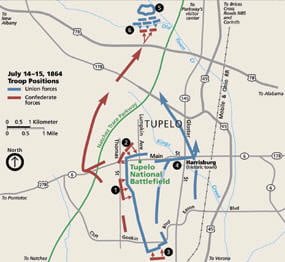
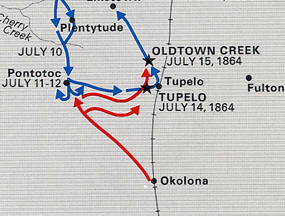 On July 11th and 12th he pressed beyond Pontotoc on the Okolona road 9 miles, but was met and driven back, and he gave up any further attempt to move southward. Gen. Forrest, in his report, says: “The delay of the enemy at Pontotoc produced the impression that he designed to fall back toward Memphis, and after a short consultation, it was determined to accept battle wherever he offered it and to attack him if he attempted to retreat.” With this understanding Gen. Lee ordered everything moved to the front. The weather was excessively warm, and Forrest’s dismounted cavalry made slow and painful marches from Okolona, first towards Pontotoc and then to Tupelo, so that when the battle was fought, after the long march, these troops arrived only about 800 strong on the field, and that after the battle.
On the 13th of July, much to the surprise of Generals Lee and Forrest, Gen. Smith, after meeting with but slight resistance in his advance towards Okolona, gave up any further effort in that direction, and moved his whole force suddenly and rapidly towards Tupelo, due east from Pontotoc 18 miles. As decided on by Generals Lee and Forrest, he was at once attacked in the rear by Gen. Forrest, with Mabry’s brigade, Forrest’s old regiment and his escort company while Gen. Lee directed Generals Chalmers and Buford to move from their positions on the Pontotoc road, and strike the enemy to the north on the road to Tupelo.
Gen. Chalmers with one brigade (Rucker’s) struck the flank of the enemy, 8 miles west of Tupelo at Bartram’s shop, and for a time had ‘possession of his train. But the enemy’s infantry rallied and forced back Gen. Rucker, after he had destroyed some wagons and killed some mules. Gen. Forrest soon joined Gen. Chalmers from the enemy’s rear. Gen. Buford attacked the enemy nearer Tupelo with Bell’s brigade, on his flank while marching. After an hour’s engagement the enemy drove back this portion of Buford’s command. At 9 p. m. Gen. Forrest had all his command united two miles from Harrisburg, at the intersection of the Harrisburg and Verona and Pontotoc and Tupelo roads the enemy being in his immediate front at Harrisburg.
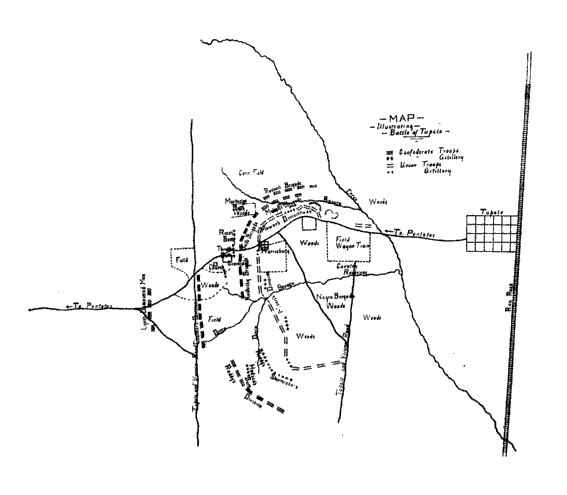
The enemy, on reaching Harrisburg near Tupelo, faced about and formed a double line of battle facing west, or in the direction of Pontotoc, with a front of two brigades. The 1st division of the 16th army corps (Gen. Mower) had its left on the Pontotoc road, the 3rd division, 16th army corps (Col. Moore) had its right on the left of the 1st division. The brigade of negro infantry was in the rear of the 3rd division, facing the left flank. The cavalry division under Gen. Grierson was in the rear, protecting the train and the right flank. The artillery (8 batteries) was divided between the two divisions of infantry and cavalry. After daylight on the morning of the 14th, the line of battle was moved forward some distance. (See report of Gen. Mower, Col. Murray, and Col. Bouton.)
In accordance with the understanding to accept battle wherever the enemy offered it, and when it was found he would not advance farther south, Gen. Forrest, after reconnoitering the position of the enemy during the night, arranged his troops for battle about daylight on the 14th of July. All the troops present were in his immediate command. The dismounted troops (about 800) had not yet arrived on the field. The line of battle was arranged as follows: Roddey’s division of Alabamians was placed on the extreme right with Hudson’s battery of artillery. Mabry’s brigade, which had been drawn from the vicinity of Jackson, Miss., to reinforce Gen. Forrest, was on the extreme left, while Buford’s division was in the center, the left of Crossland’s Kentucky brigade resting on the Pontotoc road, with Bell’s Tennessee brigade immediately in the rear of Mabry’s brigade; but this brigade was afterwards put between Crossland’s and Mabry’s brigades, making the right of Bell’s brigade rest on the Pontotoc road; Morton’s, Rice’s and Thrall’s batteries being in good position to take part in the attack. Chalmer’s division of the three brigades of Neely, McCullough and Rucker, and the dismounted men as they arrived, were to form the second line or reserve for the entire line of battle, with two batteries of artillery. The entire command was dismounted for battle. Leaving out the horse holders the Confederate force did not exceed 6,000 or 6,500 men, as against 15,ooo of the enemy, mostly veteran infantry.
The order of battle was given by Gen. Lee for Buford and Mabry to make a front attack, as the left and center of the enemy was covered by these commands, while Gen. Forrest at the same time was to swing Roddey’s division around on the enemy’s left and press it back. A signal gun was to be fired on the Pontotoc road between Bell and Crossland as the order for a general and simultaneous advance to attack the enemy. Every precaution was taken to accomplish this general movement. Both Gen. Lee and Gen. Forrest understood the desperate venture. They knew no reinforcement could be had, as all the armies of the Confederacy were facing superior numbers and resources, and everywhere Confederate armies at this stage of the war had to fight against great odds or not fight at all. On this occasion not to fight would have been to have given up the great corn region of Mississippi, the main support of other armies facing the enemy on more important fields. Whatever others may say, Gen. Lee and Gen. Forrest were in perfect accord as to delivering battle, and Gen. Forrest personally never shrank from this responsibility before or after the bloody battle.
The battle was really precipitated before it was intended, by the arrival of two reliable scouts, who reported that the enemy were evidently preparing to retreat from Tupelo northward towards Memphis on the Ellistown road. Forrest was prepared to believe this, as he states in his report: “The delay of the enemy at Pontotoc produced the impression that he designed to fall back towards Memphis.” He felt and believed all that could be done, was to fight Smith and risk the results. He advised immediate attack; his blood was up; the fire of battle was in his eye. He said that if he was in command, he would not hesitate a moment, that his scouts reported the enemy preparing to retreat on the Ripley road, (as they did the next day). Gen. Lee ordered the attack and said: “If it is to be a fight, let us fight to the bitter end, the troops are yours, select which wing you will command in person, and I will take the other.” Forrest took the right wing, which was to swing around the enemy’s flank. Lee took the left wing for the front attack to be made on Mower’s division, and the right of Moore’s division, which was covered by Buford’s Kentucky brigade on the right of the Pontotoc road.
At the signal agreed on Gen. Lee ordered the left wing to attack. Never did troops move with greater gallantry and impetuosity; gradually they advanced to the front driving the skirmishers of the enemy, until within 50 yards of their line, where the fire of the enemy was so severe that they lay on the ground, fighting desperately for nearly three hours. The Kentucky brigade on the right of the Pontotoc road had been cautioned to move surely and steadily, but it was impossible to restrain the ardor of the men, and they charged forward for nearly the entire distance. Being ahead of the troops on the right and left they drew on themselves the concentrated fire of both wings of the enemy, and after unsurpassed gallantry, some of the men falling within the lines of the enemy, they were driven back with great slaughter. Gen. Lee ordered Chalmer’s division to form on the left. He found that Chalmers had received conflicting orders. Chalmers says: “As soon as they became well engaged, I was ordered (by Gen. Lee) to advance, and while moving, received three different orders. From Gen. Forrest I received an order to move to the right and support Gen. Roddey. From Gen. Lee, to move to the left and support Gen. Mabry. And from Gen. Buford, an order stating that I could by direction of Gen. Lee, relieve him on the center. Major Gen. Forrest being my immediate superior, I obeyed his order and moved to the right, but before I had reached the desired position, another order from Gen. Lee, in person, divided my command, leaving McCullough’s brigade in reserve, and moving Rucker’s brigade to the left, to charge at double quick with a shout.” Neely’s brigade was sent to Forrest. Rucker’s brigade, after considerable delay, caused by the conflicting orders Gen. Chalmers received and his movement to the left in obeying Gen. Forrest’s order, was put on the left of Mabry and Bell, who were still holding their positions and fighting desperately. The brigade was led by both Chalmers and Rucker, but arrived too late to do much good, as the ammunition of Bell and Mabry was about exhausted, and they had met with severe losses. If any troops could have carried the lines in front of them, these brave men would have done it.
In all that has been described Gen. Lee was most intently engaged with the details of the death struggle in his immediate presence and front, but he noticed a concentrated fire of artillery and infantry on the brave troops immediately under his command, Bell, Mabry and Rucker’s brigades, from the artillery and infantry in the left wing of the enemy. (See reports of Grassland and reports of Federal officers in left division). The enemy’s artillery in his front (Lee’s) had been silenced or driven off, owing to the close proximity of our men. The enemy’s left wing then seeming to be, as in fact it was not, engaged by any Confederate troops in its front, Gen. Lee moved to the right, to see what was the cause. He soon met Gen. Forrest, and said to him: “Why did you not carry out the plan of attack?” Forrest replied: “Buford’s right had been rashly thrown forward and repulsed. In the exercise of my discretion I did not move Roddey forward, but I have moved him to the left, and formed a new line.” Gen. Lee said: “In doing as you did, you failed to carry out the plan of battle agreed on.” Gen. Lee replied it was too late then to remedy the matter and he ordered the three brigades of Bell, Mabry and Rucker to withdraw. Under the cover of McCullough’s brigade of Chalmer’s division, these heroes withdrew in order from, in proportion to the number actually engaged in their immediate front, perhaps the bloodiest field of the war. The enemy did not pursue and did not leave their line of battle. The writer wants to say here that he was on many battlefields during the four years, but he never saw greater gallantry or tenacity of purpose shown, than was shown by the troops of the brigades of Rucker, Mabry, Bell and Crossland, and the batteries of Rice, Morton, and Thrall. He will always esteem it an honor, to have personally commanded such heroes.
As to the change in the plan of battle by Gen. Forrest, he says in his report:
“Lieutenant General Lee gave the order to advance and directed us to swing the right around upon the enemy’s left. I immediately repaired to Gen. Roddey’s right, with all possible speed, which was nearly a mile distant, and after giving him the necessary orders in person, I dashed across the field in a gallop for the purpose of selecting a position in which to place his troops (See Roddey’s letter), but on reaching the front I found the Kentucky brigade had been rashly precipitated forward and were retiring under the murderous fire concentrated upon them. I seized their colors and after a short appeal, ordered them to form a new line, where they held their position. The terrific fire which was poured upon the gallant Kentucky brigade, showed that the enemy were supported by overwhelming numbers in an impregnable position. Wishing to save my troops from the unprofitable slaughter I knew would follow any attempt to charge his works, I did not push forward Gen. Roddey’s command when it arrived, knowing it would receive the same concentrated fire which had repulsed the Kentucky brigade. I ordered forward four pieces of artillery and formed a new line on the Tupelo and Verona road. Meantime the troops on my left were hotly engaged, and Mabry’s, Bell’s, and Rucker’s brigades were steadily advancing.”
Gen. Roddey never made an official report of this battle, but in a letter Gen. Lee has, he says:
“My remembrance of the battle of Harrisburg is substantially, that I was ordered by Gen. Forrest to swing the troops under my command around on the enemy’s left, covering the railroad south of his position, and to advance to the attack. The movement was executed so far that the troops were in line facing the enemy’s left and had sufficiently advanced to drive his skirmish lines on his main force (compare with Forrest’s report), when Gen. Forrest overtook us, and ordered an immediate retreat to the place where the horses were left, saying at the same time, that Buford was badly cut up, and his only reliance for the protection of his stores, lay in keeping my troops in position to keep the enemy from capturing them, adding, as I remember, that he had no other troops he could spare or rely upon for such purposes.”
Gen. Roddey really got in place in full time, and the negro skirmishers on the extreme left of the Union line were driven in before the Kentuckians made their charge. Gen. Smith says:
“On morning of the 14th the battle opened by the enemy attempting to secure a commanding position on our left. Advancing the third brigade of the third division into line with the remainder of the division and throwing out the brigade of colored troops on the left of the third, but facing nearly to its left flank, we easily drove the enemy from the hill and retained possession of it during the entire battle At about 7.30 a. m. the enemy advanced in line upon the right of the third division, near the Pontotoc road.”
There was no fighting on the enemy’s extreme left in the morning, except as described by Roddey and agrees with Gen. Smith’s report. We see, too, that Roddey had secured a commanding position, an important hill on the field and had to give it up.
About noon, soon after the withdrawal of the right wing, Gen. Lee ordered Forrest to form a new line of battle near Mrs. Sample’s house. This line was strengthened and the enemy invited by demonstration to attack, but he did not move out of his own chosen position. At night the enemy began burning all the houses at and near Harrisburg, showing preparation for retreat or movement in some direction. He was shelled by artillery during the burning. Gen. Forrest with Rucker’s brigade mounted moved cautiously to the extreme left of the enemy, approached very near, and about 10 p. m. opened fire on them. In reply, a very loud and most continued infantry fire was provoked, but it overshot Forrest and little or no damage was done. At the same time Buford’s division being moved occupied the road between the enemy and Verona, to oppose any advance in that direction.
On the morning of July 15th the enemy made no movement apparently in any direction. Gen. Buford was ordered to move up towards Tupelo, and attack the enemy; Gen. Chalmers with a mounted brigade of his division was ordered to move to the enemy’s right and see what he was about, while Gen. Roddey was moved towards Harrisburg to attack the enemy. After severe skirmishing by Gen. Chalmers, he drove the enemy back until he could see the Ellisville and Tupelo road. At 12 o’clock he saw the enemy in retreat on the road and reported the fact to Gen. Lee. At once all the commands closed on Tupelo, and began pressing the enemy. At Harrisburg Gen. Lee and Gen. Forrest met, and Lee ordered Forrest to take immediate charge and pursue and harass the enemy with his entire command. The retreat of the enemy began at 10 o’clock on July 15th, (Col. David Moore commanding 3rd division 16th army corps).
The retreat was with the same extreme caution and vigilance that had marked the advance of the enemy and his defensive battle. Gen. Buford came up with the rear of the enemy, going into camp at Old Town Creek, 5 miles from Tupelo, and with Rice’s battery and one thousand men, attacked the rear guard, and shelled their camp. He stampeded the enemy’s cavalry and train, as shown by reports of Gen. Mower and Col. McMillan (Union officers) in their official reports. But several brigades of infantry soon recrossed the creek and drove Buford back. In meantime Gen. Forrest had arrived and in the engagement was wounded. He ordered Gen. Chalmers, who had just arrived with McCullough’s brigade, to withdraw the troops. Gen. Forrest sent word to General Lee of his wound, and the necessity of his relinquishing the command. Gen. Lee at once galloped to the front, assumed command, and ordered the troops not to withdraw. Gen. Chalmers says:
“At the same time that I received this information I received orders from Gen. Forrest to assume command and withdraw the troops, as he was wounded. I returned at once to the rear and found our men falling back, and the enemy pressing up to the position on which I had left my brigade, and Col. McCullough severely wounded. I sent orders to Gen. Buford at once to form his men, and received an answer that he could not form. On repeating my order I was told that he had formed three companies. I drew McCullough’s brigade back about 400 yards in line mounted. We waited about one hour to see if the enemy would advance. As he did not, I ordered the brigade back to its camp in accordance with instructions I had received to withdraw the troops, and went in person in search of Lieutenant Gen. Lee. I found him striving to rally Gen. Buford’s division and determined not to withdraw. Gen. Buford was ordered to picket the position, which we then held and I was ordered to relieve him at 3 o’clock next morning Gen. Chalmers pursued the enemy two days.”
Gen. Chalmers in his report says:
“I cannot close this report without mentioning the robbing and desolation which attended the march of the invading army. Not only were non-combatant citizens maltreated, their houses rifled of clothing, money and other valuables, besides the theft of every pound of bacon and every ounce of meal, but the same course of rapine and cruelty was shown towards unprotected widows and orphans, who were stripped of their all, and in many cases turned out of doors, with nothing left save the wearing apparel on their persons. Cows and calves were killed from mere wantonness, and left in private yards and on public thoroughfares.”
 The action at Town Creek about ended the battle of Harrisburg, or Tupelo. For the numbers engaged it was one of the bloodiest battles of the war. The Confederates lost 210 killed and 1,116 wounded, making a total of 1,326 killed and wounded. The enemy lost 674 killed, wounded and missing; total on both sides, 2,000 men. The loss to Confederates in valuable field officers was fearful. Three brigade commanders were wounded, Rucker, McCullough and Crossland. Col. Isham Harrison and Lieutenant Colonel T. M. Nelson of the 6th Mississippi were killed, also Lieutenant Colonel J. B. Cage, 14th Tennessee; Lieutenant Colonel Sherrill, 7th Kentucky, and Major Robert McKay, 38th Mississippi, and many others were wounded. The loss of company officers was in like proportion in killed and wounded. Buford’s division, including Marby’s brigade with Bell and Crossland lost 996 men, killed, wounded and missing, over 40 per cent of those engaged, Bell losing 400, Crossland 306 out of 800 engaged, Marby 291. The 38th Mississippi, commanded by Col. J. H. Jones, went into action with 300 men. Every field and line officer except one was killed or wounded, and only 44 men out of the 300 escaped unharmed.
The enemy left the field and his wounded behind him, and the telegrams and reports show that the expedition did not accomplish what was expected. Gen. Smith did not do, after his fight, as he was required by Sherman, “persevere and continue to follow Forrest,” but from Pontotoc seemed to have but one idea: viz., to stand on the defensive and get away from him. He never left his lines, but was always on the defensive. His first dispatch, July i8th, says: “We met Lee and Walker (Forrest) at Tupelo, and whipped them badly on three different days. * * * I bring back everything in good order, and nothing lost.” He reports no trophies of victory, no guns, only 60 prisoners (no doubt wounded Confederates). He was met by an order from Gen. Sherman to Gen. Washburn (July 2Oth): “Order Smith to pursue and keep after Forrest all the time,” and another: “It was Gen. Grant’s special order, that Gen. Smith was required after his fight to pursue and continue to follow Forrest.” These telegrams tell the tale, and show Gen. Smith’s superiors were greatly disappointed in the results, and reflected on him. He had a splendid army of veteran infantry. The only time Gen. Grierson gave Smith’s cavalry a chance was at Town Creek, when one of Grierson’s brigades was stampeded by Gen. Buford with only 1,000 men.
If ever a commander had a good opportunity to move out of his lines and pursue Forrest, Gen. Smith had on this occasion, after the withdrawal of the Confederate left wing. But the dead Confederates on his lines and at thirty paces from his guns inspired him with prudence and caution even after his claimed success. He claimed his enemy lost 1,800 men, and he only 674; certainly he was still strong enough, and the enemy much weaker than before, as he saw it on the field. Smith claimed also he was out of rations and had only 100 rounds per gun for his artillery. He was ordered to take 20 days rations, and they gave out in ten days; 100 rounds to a gun would have fought another battle. He certainly was very long preparing for his expedition and he could have seen that he had no spoiled bread. He was also in a corn region and his troops killed, wantonly, enough cattle to have furnished beef for his command.
On the Confederate side blunders and mistakes complicated matters. The troops were all of Forrest’s command, and he should have had supreme command, but he insisted on Gen. Lee’s, the department commander, assuming the responsibility and being present. Forrest had just won his splendid victory at Brice’s Cross Roads over Gen. Sturgis, and his troops had confidence in him. Gen. Lee used this argument to insist on his commanding on the field, but he said no; that the responsibility was too great, and that his superior in rank should assume and exercise the command; that he considered the Confederate troops inadequate to defeat Smith. He also said his health was not good and Gen. Lee must take charge. The first unfortunate circumstance was the precipitate charge of the Kentuckians; they drew on themselves the fire of both wings of the Union army before the troops on right and left of them were up. While the conflict was raging on the left wing, Gen. Forrest changed the plan of battle by withdrawing Roddey and forming a new line with Roddey, the dismounted men, and Neely’s brigade. This caused all the artillery in the Federal third division, several batteries in all, and most of the infantry, to fire continuously into the flank of the brigades of the Confederate left wing. Col. Murray, of the 89th Indiana, commanding the 1st brigade, 3rd division on Mower’s left, his right resting on the Pontotoc road, says:
“Enemy formed several lines on right of Pontotoc road, directly in front of Mower’s left brigade. The entire artillery of my line (12 guns), with 122 Ill’s (regiment) occupying my right, opened up and continued most of the time of the action a murderous cross fire on the enemy in that wood field and contributed very much to the glorious results of the day, in driving back and repulsing the enemy from their position.”
The right wing of the Federals was also reinforced by troops sent from their left wing when Rucker became engaged.
Back to: Mississippi History